
Imagine walking into a venue where the lighting transforms an ordinary space into something extraordinary—where colors shift seamlessly from warm amber during dinner to pulsing blues and greens as the dance floor ignites. How do professional event producers achieve that kind of vibrant, dynamic illumination that sets the mood and captivates audiences? The answer, more often than not, begins with PAR lights. These versatile fixtures have earned their place as the industry-standard workhorse for stage lighting, trusted equally at intimate corporate gatherings and massive concert tours. Whether you need to wash a stage in rich color, highlight architectural details, or create dramatic visual moments synchronized to music, PAR lights deliver consistent, powerful results. This article aims to demystify PAR lights and their control through DMX technology, giving event planners the knowledge they need to confidently specify, set up, and operate professional lighting systems that elevate any occasion from ordinary to unforgettable.
What Are PAR Lights? The Backbone of Modern Stage Lighting
PAR stands for Parabolic Aluminized Reflector, a name that describes the fixture's fundamental engineering. At its core, a PAR light consists of three essential components: a lamp or LED array housed within a cylindrical metal casing, a parabolic reflector that gathers and directs light forward, and a lens that shapes the beam's spread and texture. This elegantly simple design has made PAR fixtures the most recognizable silhouette in professional lighting for decades.

The technology has evolved dramatically since the original PAR cans of the 1960s and 70s, which relied on sealed-beam incandescent lamps that ran hot, consumed enormous power, and required colored gel filters taped over the front. Today's LED-based PAR fixtures represent a quantum leap—they produce vibrant, saturated colors internally through RGBW color mixing, generate minimal heat, draw a fraction of the electricity, and last thousands of hours without lamp replacements. Despite this technological transformation, the form factor remains familiar and trusted. Their rugged aluminum or steel housings withstand the rigors of touring, their output punches through ambient light in venues of all sizes, and their versatility allows them to function as washes, uplights, or accent fixtures with equal effectiveness. For event planners, this combination of reliability, performance, and adaptability makes PAR lights the logical foundation for any lighting design.
Key Features and Benefits for Event Professionals
What makes modern LED PAR lights indispensable comes down to a handful of features that directly impact event quality and logistics. High light output ensures your fixtures cut through even in daylight-adjacent environments or large ballrooms, while impressive throw distances mean fewer fixtures can cover more area. The robust, road-ready construction—typically featuring powder-coated metal housings and protective lens guards—means these fixtures survive repeated load-ins, transport, and outdoor exposure without performance degradation.
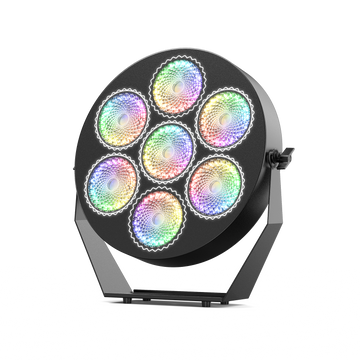
Beam angle options give you precise creative control. Narrow beams (around 15-25 degrees) create focused pools of light ideal for spotlighting speakers or centerpieces. Medium beams (25-40 degrees) work beautifully for stage washes and architectural highlighting. Wide flood options (50 degrees and above) deliver broad, even coverage for wall washes and general ambient lighting. Many modern fixtures offer interchangeable lenses or motorized zoom to switch between these applications on the fly.
LED technology delivers practical advantages that matter on event day: energy efficiency means you can run more fixtures on fewer circuits, low heat output keeps performers comfortable and reduces HVAC strain, instant on/off capability eliminates warm-up delays, and lamp life measured in tens of thousands of hours eliminates mid-event failures. Perhaps most transformative is RGBW color mixing—by blending red, green, blue, and white LEDs at varying intensities, a single fixture produces virtually any color imaginable without physical gel changes, giving you unlimited palette flexibility from one position.
Demystifying DMX Control for Stage Lighting
Think of DMX—Digital Multiplex—as the universal language that lets every light in your rig listen, respond, and perform on cue. If your PAR lights are the musicians in an orchestra, DMX is the conductor, sending precise instructions to each instrument about when to play, how loudly, and what note to hit. Without it, you'd be manually adjusting each fixture by hand—an impossibility when you're running dozens of lights through multiple scene changes in a single evening.
The DMX system operates through a straightforward signal chain. A controller—whether a dedicated hardware console, a compact desktop unit, or software running on a laptop—generates commands. Those commands travel through standard DMX cables (5-pin or 3-pin XLR connectors) to your first fixture, then daisy-chain from one fixture to the next in sequence. Each fixture along the chain reads only the instructions addressed to it, ignoring everything else. This means one controller can independently manage color, intensity, and effects on every single PAR light in your setup simultaneously. For event planners, learning how to control lighting effectively with DMX systems eliminates guesswork and puts real-time creative authority in your hands or your technician's hands, ensuring every lighting transition happens precisely when it should.
How DMX Works: Addresses, Channels, and Universes
Every fixture on a DMX chain needs a unique starting address—think of it as a mailing address that tells the controller exactly where to send specific instructions. You set this address directly on the fixture, typically through a small digital display or DIP switches on the back panel. The first fixture might be set to address 1, the next to address 7, and so on, depending on how many channels each fixture requires.
Channels represent the individual parameters you can control on each light. A typical RGBW LED PAR might use six channels: one for overall dimmer intensity, one each for red, green, blue, and white LED levels, and one for built-in strobe or effect programs. When you set a fixture's start address to 1, it occupies channels 1 through 6. The next fixture should then start at address 7 to avoid conflicts. Your controller sends a value between 0 and 255 on each channel—0 meaning fully off, 255 meaning maximum output—giving you fine-grained control over every attribute.
A single DMX universe contains 512 channels total. For most events, one universe is more than sufficient to control an entire rig. However, large-scale productions with hundreds of fixtures can expand into multiple universes, each carrying its own 512-channel capacity, managed through a single advanced controller or network system.
Choosing the Right PAR Lights for Your Event
Selecting the ideal PAR fixtures requires matching your equipment to your specific venue conditions, creative goals, and practical constraints. Start by considering the LED versus traditional incandescent question—though for most modern applications, LED wins decisively. LED PARs eliminate the ongoing cost of lamp replacements and gel filters, produce negligible heat that won't stress climate control systems or discomfort performers, and draw so little power that you can safely run a dozen fixtures from a single standard circuit. Traditional incandescent PARs still exist in some rental inventories and offer a warm, familiar quality, but their operational costs and limitations make them increasingly impractical for event work.
Brightness requirements depend directly on your venue. A small conference room or intimate reception space needs far less output than a cavernous ballroom or outdoor festival stage competing with ambient daylight. Assess your throw distances—how far the light must travel from fixture to subject—and match that against manufacturer specifications to ensure adequate coverage without over- or under-powering your design. Beam angle selection shapes your creative intent: choose narrow beams for dramatic spotlighting of keynote speakers or table centerpieces, medium spreads for even stage washes, and wide floods for seamless wall coverage or general ambiance. Two features should be non-negotiable on your specification list. First, full DMX control compatibility ensures every fixture integrates into a unified, programmable system rather than operating in isolation. Second, RGBW color mixing capability guarantees you can produce any hue your design demands—from subtle pastels to deeply saturated primaries—without carrying cases of gel filters or swapping fixtures mid-event. Brands like UKING offer DMX-compatible LED PAR fixtures that check these boxes while remaining accessible for event planners building or expanding their lighting inventory.
Step-by-Step Guide to Setting Up a Basic PAR Light System with DMX
Getting your first DMX-controlled PAR light system running is more straightforward than most event planners expect. Follow this process to go from boxes of gear to a fully operational, programmable lighting rig in under an hour.
Begin with physical setup. Mount your PAR fixtures on truss, lighting stands, or ground-plate positions according to your design plan. Secure each fixture with a safety cable in addition to its clamp, then run power cables to each unit. With LED PARs drawing minimal current, you can typically power four to six fixtures from a single 20-amp circuit without concern—but always verify your total draw against circuit capacity before energizing.
Next, wire your DMX chain. Run a DMX cable from the controller's output to the DMX input on your first fixture. From that fixture's DMX output, run another cable to the input of the second fixture, continuing this daisy-chain pattern through every light in the rig. At the final fixture, install a DMX terminator plug on the unused output to prevent signal reflections that cause flickering or erratic behavior.
Now assign DMX addresses. If your PAR lights use six channels each, set the first fixture to address 1, the second to address 7, the third to address 13, and so on—each starting address offset by the channel count to prevent overlap. Use the fixture's rear display or DIP switches to dial in the correct number.
With addressing complete, power on your controller and patch your fixtures. On a basic DMX console or software interface, assign faders or virtual sliders to correspond with each fixture's channels. Push the dimmer channel to 255 for full intensity, then experiment with the red, green, blue, and white channels individually—blending them to create your desired colors. Save these combinations as scenes or cues that you can recall instantly during the event.
Finally, test everything before doors open. Walk the room, verify each fixture responds correctly to its assigned controls, confirm colors match across all units, and run through your programmed cues in sequence to ensure smooth transitions. This rehearsal catches addressing errors, cable faults, or programming mistakes while you still have time to fix them.
Creative Applications for Event Planners
Once your PAR lights and DMX system are operational, the creative possibilities expand far beyond basic illumination. Consider color washing a backdrop behind a keynote speaker—programming a deep corporate blue that subtly shifts to the brand's secondary color during transitions between presenters, all triggered from a single cue on your controller. For galas and receptions, uplighting transforms plain ballroom walls into rich, textured canvases; position PAR fixtures at floor level aimed upward along columns or drapery, and cycle through warm ambers during cocktail hour before transitioning to vibrant jewel tones as the evening's energy builds.
Audience lighting creates immersive experiences that make attendees feel part of the show rather than passive observers. Aim wide-flood PARs toward the crowd during high-energy moments—a product reveal, a toast, or a musical performance—and use DMX to trigger color chases that ripple across the room in time with music. Even simple programming delivers dramatic impact: a slow crossfade between two complementary colors adds movement and sophistication to otherwise static scenes. The real power of DMX control lies in this ability to pre-program every transition, store dozens of looks, and recall them instantly throughout an event's timeline without touching a single fixture. What once required a crew of technicians swapping gels and adjusting dimmers now happens with one button press, giving planners unprecedented creative authority over their event's atmosphere.
Elevate Your Events with PAR Lights and DMX Mastery
PAR lights have earned their reputation as the most versatile and reliable fixtures in professional event lighting for good reason. Their combination of powerful output, rugged construction, and RGBW color mixing capability makes them suitable for virtually any application—from subtle corporate uplighting to high-energy concert washes. When paired with DMX control, these fixtures transform from simple light sources into precisely orchestrated instruments capable of creating atmosphere, directing attention, and evoking emotion throughout an event's timeline. The technical fundamentals covered here—understanding addresses, channels, daisy-chain wiring, and scene programming—represent everything you need to operate a professional lighting system with confidence. What might seem intimidating on paper becomes intuitive once you connect a few fixtures, assign addresses, and watch your first programmed cue come to life exactly as designed. Start small: pick up a basic DMX controller and a handful of LED PAR fixtures, wire them together following the steps outlined above, and experiment with color mixing and scene building. You'll quickly discover that professional-quality lighting is far more accessible than you imagined, and the impact it delivers for your clients and audiences is transformative.